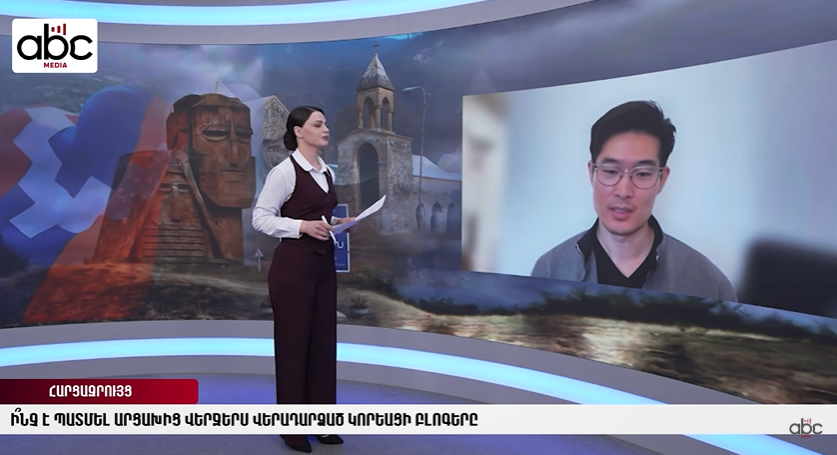
Korean traveler reflects on visit to Artsakh
Korean blogger Young Min has visited 129 countries around the world, and recently traveled to occupied Artsakh. He says the trip was physically, mentally, and emotionally very challenging. The journey lasted roughly 48 hours, during which he barely slept.
Young Min first heard about Nagorno-Karabakh in school, but after the 2020 war, he began studying the region’s history in more depth.
“It was a land with a lot of different cultures,” Young told ABC Media, stating that it was difficult to remain objective while witnessing the destruction and tragedy in Artsakh.
Young Min visited Artsakh during the period when the Azerbaijani government opened entry permits for foreigners, and he decided to take the opportunity. However, upon entering the region, he was confronted with a tragic scene: old, abandoned buildings, damaged houses, many of them empty. In Stepanakert, the scale of destruction was much greater — the city was filled with abandoned homes and buildings.
Akna (Aghdam) was full of new buildings, reflecting Azerbaijan’s “Great Return” program, according to Young.
“That’s what the government is trying to show the world and I saw it, and it was truly impressive, the scale that they were moving at,” he says.
Young added that he did not communicate with Azerbaijani locals because time was limited, and the tour organizers preferred to avoid such interactions. The only people he talked to were the people in the restaurant. He explained that the trip was highly structured, with visited sites and stops primarily showcasing Azerbaijani, Persian, and Muslim history, while almost no information was presented about Armenian culture.
“The conditions of the trip were pretty brutal. Well, first the van was much smaller than we thought. So, it was very cramped. It was 6-6.5 hours there to finally reach Artsakh and we were able to finally get out of the van. So, along the way there from Agdam all the way into Stepanakert was 1 hour and a half. It was unpaved roads. Of course, because you know it was all a buffer, a frontier, so, it was very brutal—lots of dust, and you know, engine fumes, so, I was feeling very sick,” Young says.
“We asked some questions, but the Armenian questions were kind of deflected, and we were just given more Azeri, Muslim, Persian information.”
According to the blogger, his goal was to show Armenians and the world the consequences of war and destruction.
“My message and hope after all of this is that Armenia can use this to power forward, to continue to look forward and advance and thrive and prosper,” he says.
Young states that this story is not only about Armenians, but about any country affected by war. “The cycle of hate and violence needs to end,” he says.
Young works in the IT sector; traveling is an important part of his life. He believes that each journey gives him the opportunity to see historical and cultural realities firsthand and share them with the world.
He hopes his videos will help people understand the impact of the past, while also reminding them to look forward, develop their countries, and build a safer, brighter future — so that such tragedies are never repeated.