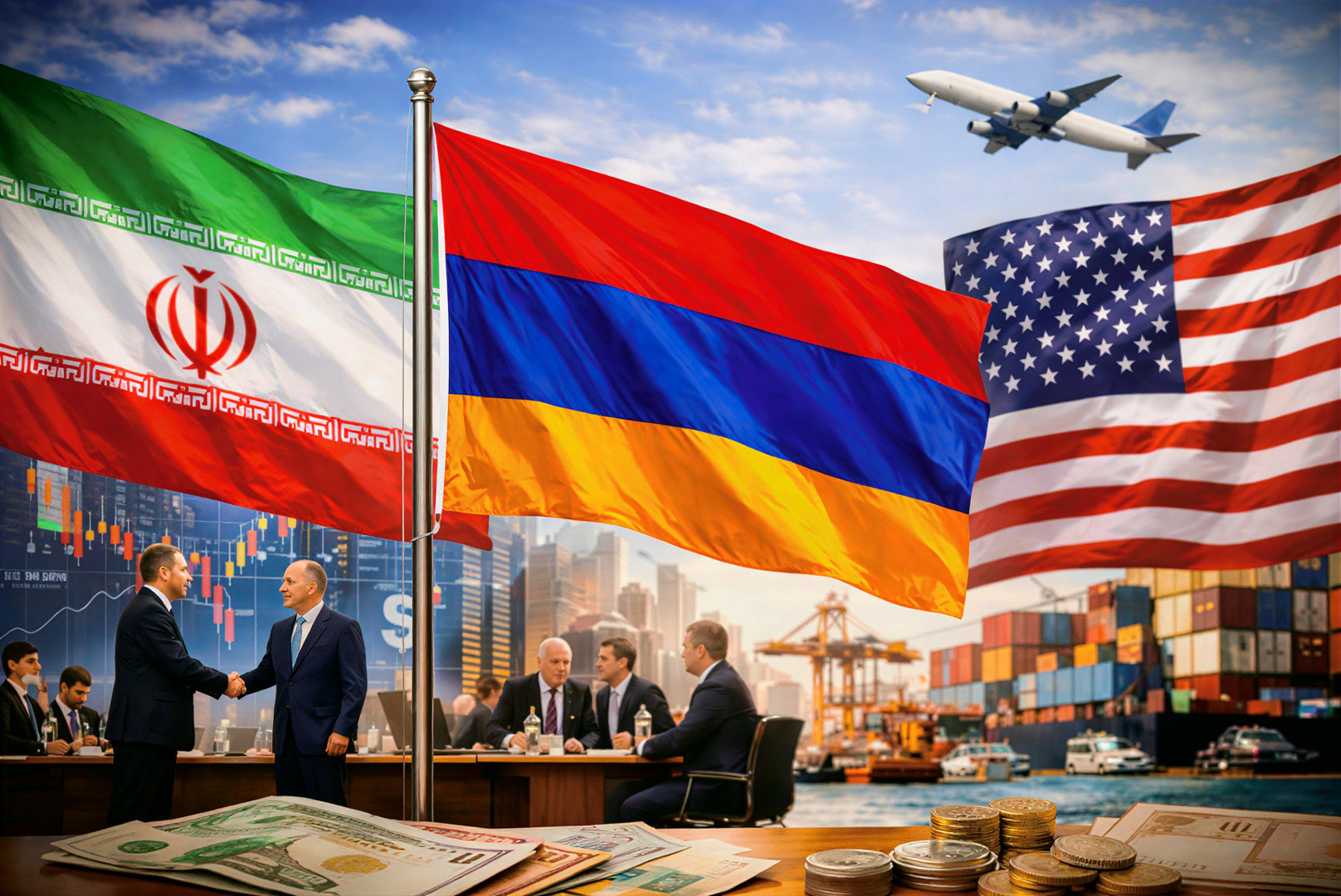
Armenia finds itself caught between the US and Iran, Special Eurasia writes
US President Donald Trump has publicly announced the introduction of a 25% tariff on countries trading with Iran. U.S. President Donald Trump has announced the imposition of a 25% tariff on countries trading with Iran. According to an analysis by Special Eurasia, this could put Armenia under secondary economic pressure due to its structural dependence on Iran in the energy and communications sectors.
Iran’s internal unrest and economic fragility increase the likelihood of disruption to Armenia’s southern lifeline at a time of heightened regional insecurity.
The imposition of US tariffs fundamentally alters Yerevan’s strategic calculus. Secondary economic pressure from the United States risks deterring investment, complicating financial transactions, and constraining Armenia’s ability to maintain essential economic exchanges with Tehran without incurring external costs.
Simultaneously, a severe degradation of Iranian state capacity—or, in an extreme scenario, partial collapse—would remove Armenia’s only viable southern outlet, intensifying its isolation.
These dynamics unfold against the backdrop of volatile relations between Armenia, Azerbaijan, and Turkey. Following recent conflicts and ongoing negotiations, Yerevan’s security environment remains fragile. Any weakening of Armenia’s economic resilience or logistical flexibility directly benefits its regional adversaries by narrowing Yerevan’s strategic options.
Efforts to deepen cooperation with Western partners and develop alternative corridors may mitigate long-term risk, but they are unlikely to fully offset the immediate strategic value of Iran in the short to medium term.
For Armenia, whose borders with both Azerbaijan and Turkey have remained closed for years, the Islamic Republic has constituted a critical outlet and a source of strategic depth. This is particularly true for the southern province of Syunik, whose importance has grown as Azerbaijani political rhetoric has increasingly referred to the area as “Western Azerbaijan”, sustaining concerns in Yerevan over the possibility of renewed military pressure. In this context, Tehran has served not only as an economic partner but also as a stabilising factor, anchoring Armenia’s southern flank and advocating for its territorial sovereignty.
The tightening of United States pressure on Iran’s partners places Armenia in an increasingly difficult position. As Yerevan deepens its political and economic engagement with Washington and Brussels, and advances along a European integration trajectory, relations with Moscow have declined. Within this framework, the proposed development of the TRIPP corridor along Armenia’s border with Iran has been received in Tehran with open hostility. Iranian authorities have framed the project as an intrusion by external powers into the regional balance, as well as a potential platform for hostile intelligence activity directed against the Islamic Republic. Whether intentionally or not, Yerevan risks becoming entangled in the wider and still unresolved confrontation between the Washington–Tel Aviv axis and Tehran.