
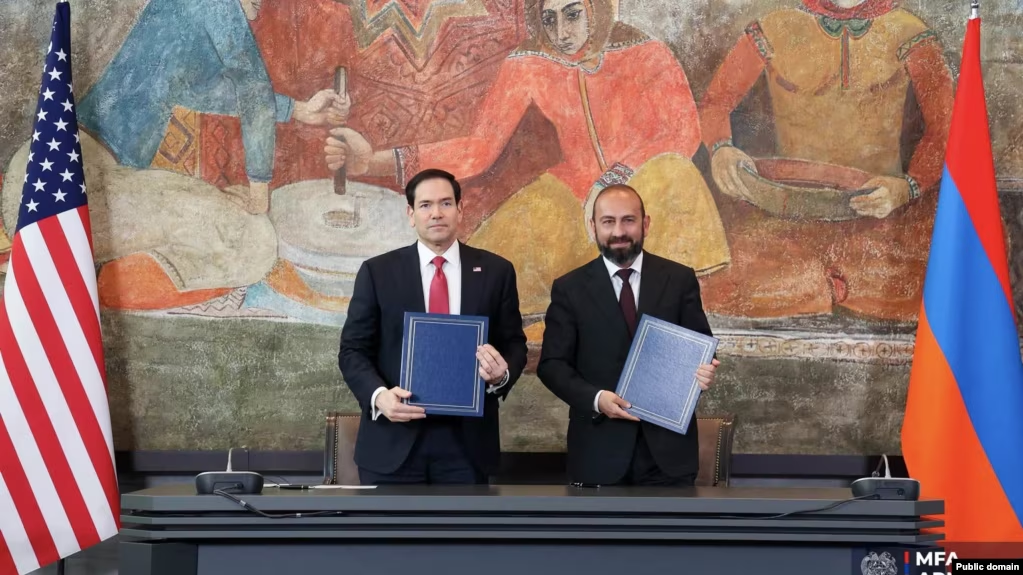
State Department official: Yerevan and Baku were acting as though peace were "inevitable," although additional steps remain before a final agreement can be completed
The United States is set to unveil the next stage of its effort to develop the Trump Route for International Peace and Prosperity, or TRIPP, a planned transport and infrastructure corridor through southern Armenia that Washington says could open new trade routes between the South Caucasus, Central Asia, and Western markets, Radio Free Europe/Radio Liberty writes.
Senior State Department officials told reporters that the New York event on September 23 will focus on the institutional and financial mechanisms needed to move TRIPP from last year's Armenia-Azerbaijan peace initiative toward implementation.
The event is expected to bring together the foreign ministers of Armenia and Azerbaijan, representatives of the five Central Asian states -- with Kazakhstan and Uzbekistan showing particular interest -- US special envoy Steve Witkoff, Republican Senator Steve Daines, and executives from more than 40 companies, many of them American.
"This becomes a major security issue for us," the official said to RFE/RL, describing the removal of existing trade "choke points" as a central objective.
The transit route will be developed and managed by a US-controlled company, giving Washington exclusive rights while effectively excluding Russia from a strategically important project in one of its traditional spheres of influence.
A senior State Department official said Yerevan and Baku were acting as though peace were "inevitable," although additional steps remain before a final agreement can be completed. Washington intends to develop TRIPP in parallel with that process, arguing that greater economic integration could help remove remaining obstacles. Despite plans to move TRIPP toward implementation, construction of the roughly 43-kilometer section through Armenia is not yet ready to begin. The section is expected to include a railway, road, pipelines, electricity infrastructure, and digital data links.
The senior State Department official said Azerbaijan has already been building infrastructure toward the Armenian border at its own expense, while Turkey is similarly developing infrastructure up to the border. The remaining section through Armenia is still to be developed.
The railway will take longer. A feasibility study is expected by the end of 2026 or early 2027, after which companies will be able to bid. The official said completing the railway would likely take at least 18 months, complicated by difficult topography.
Electricity connections could come sooner. Discussions are already underway, with officials expecting electricity operations to begin in 2027, potentially linking the Armenian and Azerbaijani grids with wider Central Asia, Turkish, and European regional networks. Passenger rail is also planned.
The briefers provided more detail about the planned structure of the TRIPP Development Company (TDC) but no names for its future leadership.
The TDC is being established as a corporate joint venture between the US government and Armenia. The senior State Department official described it as a first-of-its-kind arrangement in which the US will hold a majority stake, with its own board, voting procedures, and management. Several legal matters still need to be finalized before the company can formally be announced.
Projects involving rail, roads, electricity, oil, gas, and data will go through regular tender processes for construction or concessions. The US Development Finance Corporation (DFC) has been involved in the legal and institutional setup, but the TDC itself will operate as a separate US-Armenian corporate entity.
Officials described TRIPP as an alternative to existing east-west routes, with the proposed corridor offering Central Asian trade another route to Western markets that bypasses Russia and Iran.
The senior State Department official said Washington had held discussions with regional competitors but declined to characterize their private views.
"There have been numerous conversations with all of the competitors in the region," the official said, adding that Washington was aware of the potential for "hard conversations" in what officials called a difficult neighborhood.
While Washington says Armenia and Azerbaijan are on an "irreversible path to peace," their final peace agreement has yet to be completed.