IntelliNews։ Pashinyan used the word “peace” 144 times over a six-month period, while Aliyev used it just 34 times
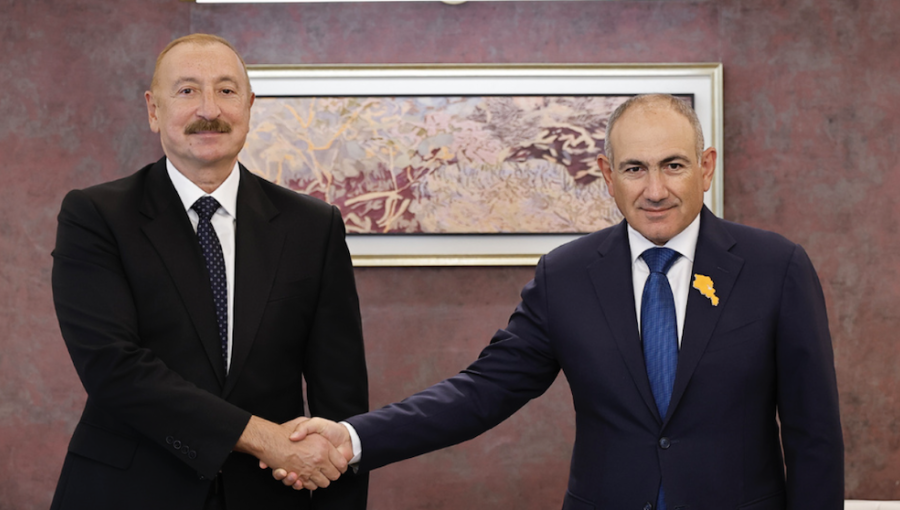
There is a clear disconnect between the ways Azerbainjai President Ilham Aliyev and Armenian Prime Minister Nikol Pashinyan talk about relations between their two countries. An analysis of 20 speeches delivered by the two leaders between late May and early November 2026, by IntelliNews' Lambda tool, reveals Pashinyan talks about peace with Azerbaijan more than four times as often as Aliyev, whose speeches repeatedly return to ''occupation'' and ''military victory''.
IntelliNews Lambda analysed 10 speeches by each leader, with a total length of around 26,000 words apiece, finding that Pashinyan used the word peace and its derivatives 144 times. Aliyev used them 34 times, while words built on "occupation" appeared 56 times in his speeches. Pashinyan mentioned occupation twice.
Both leaders can therefore say the war is over, but their speeches tell different stories about what peace means.
Aliyev's account of the conflict follows a consistent script. ''Armenia occupied around a fifth of Azerbaijan for 30 years and displaced nearly a million people; international organisations failed to resolve the dispute; Azerbaijan won the 44-day war in 2020 and forced Armenia to sign what he calls "an act of capitulation". Peace subsequently became an Azerbaijani initiative''.
Peace is also his justification for maintaining military strength. Explaining why Azerbaijan must continue arming, Aliyev told the congress: "Our people have faced the ingratitude of the Armenians. They saw that we were a little hesitant, they saw that we had stumbled, they stabbed us in the back."
Azerbaijan must be "10 times stronger than them every day", he said, as the government set aside approximately AZN 9bn ($5.3bn) for defence and security spending in its 2027 budget.
His assessment has shifted from "peace is a reality" in June to "this peace is still fragile, it needs to be protected and strengthened" in October.
Aliyev's rhetoric is not simply a case of adopting a hard line for domestic audiences and a conciliatory one for foreigners.
At domestic economic meetings on agriculture in May and mining in September, Armenia appeared only as the former occupier accused of cutting off water supplies and plundering natural resources. Neither speech mentioned peace.
At Baku Energy Week on June 1, addressing oil executives and investors, he said Azerbaijan had "completely defeated Armenia in just 44 days". He presented the Washington summit as the legal basis for the Zangezur corridor, without mentioning peace or the American-backed name for the route, the Trump Route for International Peace and Prosperity (TRIPP).
His warmest speech came at the Shanghai Cooperation Organisation's SCO Plus meeting in Bishkek on September 1, the only one of the 10 to describe cooperation with Armenia as a present-day fact.
His harshest speech was also delivered to foreigners. At the October 15 summit of the Conference on Interaction and Confidence Building Measures in Asia (CICA) in Baku, Aliyev said Armenia's current leadership had continued the "criminal policies" of its predecessors since 2018. He described the trials of former Artsakh leaders in Baku as "an analogue of the Nuremberg Tribunal", with "Armenian fascists" in the dock.
Pashinyan's message changes little between speeches. Peace was established on August 8, 2025, thanks in large part to US President Donald Trump; the treaty has been initialled and must be signed and ratified; the countries recognise their Soviet-era borders under the 1991 Alma-Ata Declaration; and TRIPP will reopen regional transport routes.
"Peace between Armenia and Azerbaijan is an established fact," he told CIS leaders on October 9. He also gave the only credit to Aliyev found in his 10 speeches: "with the support of the President of Azerbaijan and our international partners, we have achieved the impossible".
Like Aliyev, he never names his counterpart. Unlike the Azerbaijani president, he rarely criticises the other side directly.
His closest approach to a direct complaint about Baku came in parliament on August 24, when he said "it is impossible to deny that Azerbaijan is very actively raising and even instrumentalising the topic of constitutional reforms".
For foreign audiences, Pashinyan presents peace primarily as an economic opportunity.
Domestically, Pashinyan uses peace as a weapon against political opponents, whom he accuses of seeking a return to conflict.
TRIPP has progressed more slowly.
Pashinyan needs six opposition votes in parliament to send a new constitution to a referendum. Opposition parties have lined up against the changes, and he has not ruled out an early election if he cannot secure their support.
Until the treaty is signed and ratified, the settlement must survive both versions of what peace means.