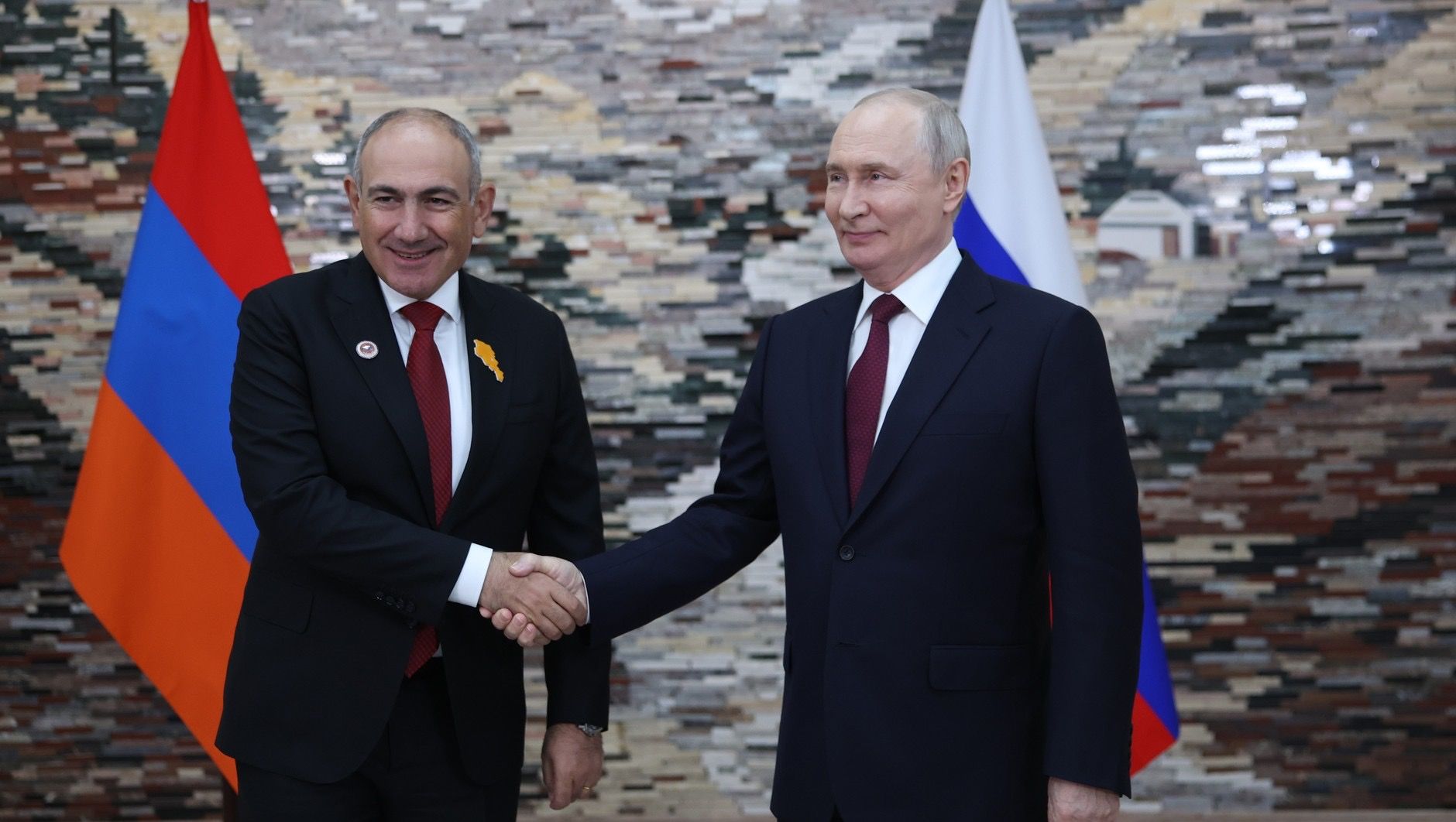
Press Review: Putin reminds Pashinyan that Political choices have economic costs
Armenia must decide which option would be more beneficial for it: maintaining its membership in the Eurasian Economic Union (EAEU) or pursuing integration with the European Union (EU). During a new meeting with Armenian Prime Minister Nikol Pashinyan, Russian President Vladimir Putin made it clear that Moscow’s position remains unchanged.
Alexey Pilko, Director of the Eurasian Communication Center, told Росбалт that Putin’s objective is not to force Armenia to reconsider its approach to integration with the EU. Nor is there even an objective to simply persuade Pashinyan to change his mind. Instead, there is a joint statement by the EAEU member states adopted in Astana on May 28 this year, which recommends that Armenia hold a referendum so that its people can decide which path the republic should pursue going forward.
According to the expert, there are no signs that Pashinyan is ready to hold a referendum and put the issue of EU integration to a vote. At the same time, what matters to him now is that Russia ease its restrictions on Armenian products and restore access to its markets.
Коммерсантъ writes that Nikol Pashinyan appeared nervous. If he had not been nervous, he would not have forgotten to button his jacket as he approached Vladimir Putin. Nor, after walking past the journalists with Putin, would he have hurriedly begun buttoning it in front of the cameras, when another handshake was expected to be captured and a second later, as he sat down, he wouldn't have unbuttoned his jacket again.
Nikol Pashinyan explicitly stated that Armenia itself does not intend to leave the EAEU and that it cannot be expelled. He had hinted at this before, but had never expressed it so unequivocally.
Deutsche Welle notes that the Armenian government’s own program, which sets out the new Cabinet’s policy priorities for the next five years, makes no mention either of joining the EU or submitting an official application for membership. At the same time, Brussels emphasizes that EU membership is a lengthy process based on strict compliance with clearly defined European values.
Many experts are questioning why the Armenian leadership has decided to accelerate the EU accession process so sharply, while also pointing to the fact that Pashinyan’s statements come against the backdrop of deteriorating relations with Russia and the EAEU.
MK writes that in Bishkek, Yerevan was reminded of a simple fact: political choices come with an economic price. For Moscow, general statements about maintaining the partnership are no longer sufficient. It wants clarity about the direction in which Armenia intends to move next.